Snake Puzzle: Slither to Eat
Brave HK LimitedPuzzle
4.41.72K Reviews
- Version
- 13.6.3
- Installs
- 10.00M
- Age Rating
- Everyone
Screenshots
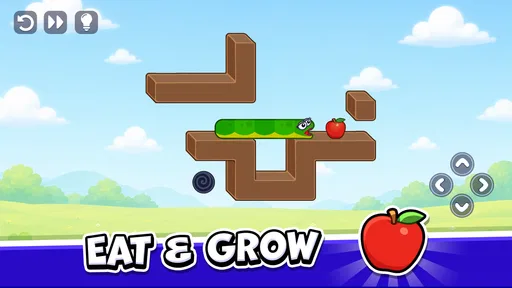
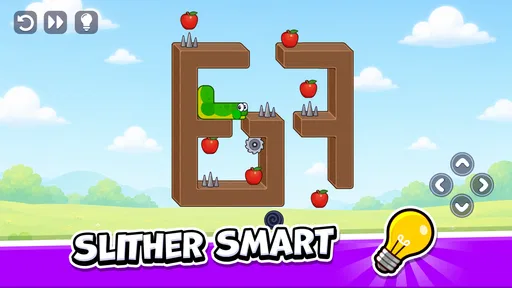
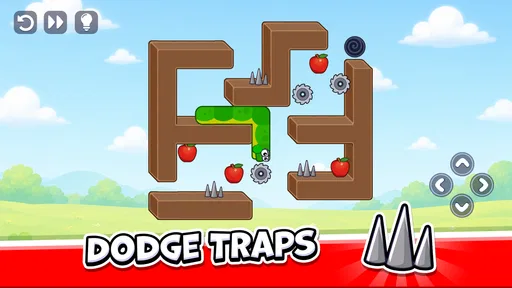
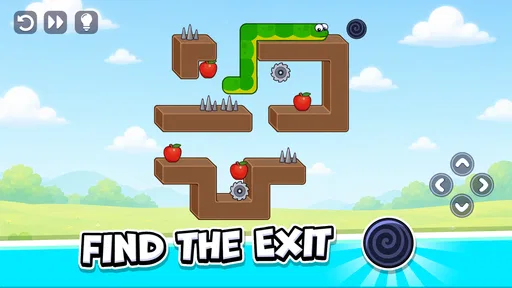
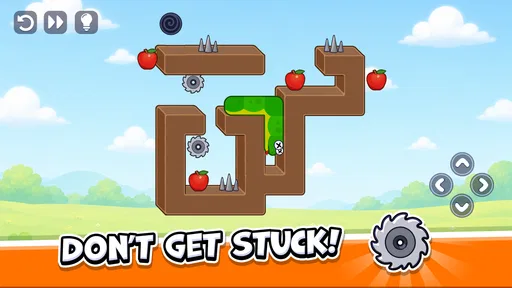
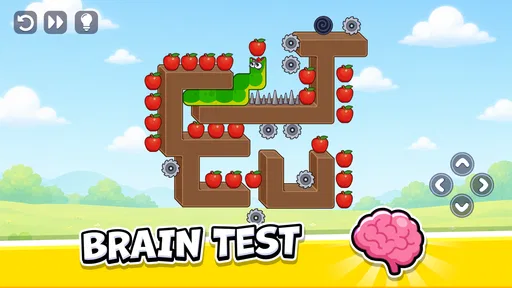
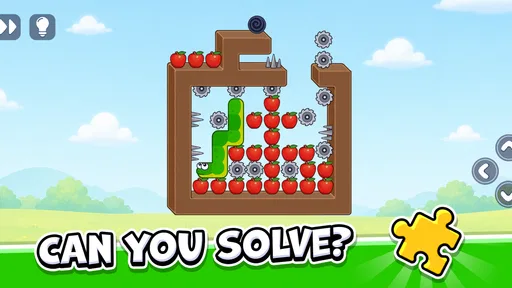
Our Review of Snake Puzzle: Slither to Eat
 Analysis by Appyee
Snake Puzzle: Slither to Eat looks simple at first: guide a snake, reach apples, and solve compact puzzles without getting trapped. After spending time with it, I found that its appeal comes from the way it turns a familiar arcade idea into a slower, more deliberate puzzle routine. The snake is not just something to steer quickly; every movement changes the space available for the next one. That small shift makes each level feel more like planning a route than chasing a high score.
As a free puzzle game from Brave HK Limited, it is easy to try without committing money up front. It is also rated for Everyone, which makes the presentation approachable for younger players and for adults who want something calm rather than intense. The game has built a sizeable audience, with an average rating of 4.4 from around 127 thousand ratings and over 10 million installs. Those figures do not replace personal experience, but they do suggest that the basic idea is reaching people beyond the usual snake-game audience.
My first impression was that the game understands the value of restraint. It does not need a complicated premise to make a level interesting. The central question is usually practical: where can the snake move now, and what will that movement prevent later? That makes it a useful choice for short sessions, especially when I want a game that gives my attention something specific to work on without demanding a long story or a large time investment.
How the visual language turns a familiar snake into a puzzle character
The visual identity is built around clarity. The snake, the apples, the boundaries, and the usable paths need to be readable at a glance, because a puzzle based on movement becomes frustrating when the player cannot quickly understand the board. Here, the setting feels designed to support the act of solving rather than compete with it. The board is the stage, the apple is the immediate goal, and the snake’s growing body becomes the main source of tension.
That approach gives the game a coherent mood. It is playful without feeling noisy, and it keeps the focus on small decisions. I never felt that the visual treatment was trying to turn a straightforward puzzle into something more dramatic than it needed to be. Instead, the presentation makes the familiar snake concept feel tidy and inviting, which is important for a game that depends on repeated attempts.
The best part of this visual language is how it supports mental mapping. I can look at a level, identify the important obstacles, and imagine a few possible routes before moving. That is more valuable than decorative detail in this particular genre. A visually crowded board would make mistakes feel arbitrary, while a clean board makes them feel connected to my own planning.
There is also a useful contrast between the snake’s apparent simplicity and the difficulty of controlling its future position. A short snake may leave several options open, but after eating, the body occupies more of the board and turns previously safe routes into dead ends. The art direction helps communicate that change immediately. I do not need a long explanation to understand that growth is both the reward and the problem.
Why the setting works best when I treat it as a thinking space
I would not play this for a rich fictional world. There is no need to invent a story around every apple or expect the setting to deliver the depth of an adventure game. Its world is more functional: a collection of spaces arranged to make movement meaningful. That is not a weakness by itself. For this kind of puzzle, a restrained setting lets me concentrate on the relationship between position, length, and available routes.
This also makes the game suitable for different moods. I can open it during a short break and begin understanding the task almost immediately. I do not have to remember a plot, manage a large inventory, or reconstruct a complicated control scheme. The visual language tells me what matters, and the puzzle supplies the rest of the engagement.
One practical tip is to stop treating the apple as the only target. Before moving, I look at the spaces the snake will occupy after reaching it. That small habit prevents many unnecessary restarts. The most attractive route is not always the safest one, and the board often rewards leaving room to turn rather than taking the shortest visible path.
Sound, pacing, and the feeling of a controlled session
The game’s sound and rhythm work best as support rather than spectacle. This is not the sort of puzzle I would choose for a dramatic soundtrack or constant audiovisual stimulation. Its mood depends on giving each decision enough room to register. The pacing encourages me to slow down, inspect the board, make a move, and then reassess the new shape of the puzzle.
That rhythm is especially effective because the core challenge is sequential. A careless move does not merely lose a few seconds; it can remove the route needed for the rest of the level. The calmer tempo gives me a chance to notice that consequence. Instead of reacting to a fast stream of obstacles, I am watching the board gradually become more or less manageable.
I also like that the game’s mood does not rely on making every moment feel urgent. Many mobile puzzle games add pressure through timers, rapid animations, or aggressive reward loops. Snake Puzzle: Slither to Eat feels more comfortable when approached as a quiet exercise in spatial reasoning. The satisfaction comes from seeing a route that initially looked impossible become clear after I change the order of my moves.
That pacing has a trade-off. Players who want constant action may find the experience too measured, particularly if they expect the word “snake” to mean quick reflexes and arcade speed. The game is closer to a board puzzle with a snake-shaped tool than to a traditional chase game. I think that distinction matters before downloading it, because the title may suggest a faster experience than the actual decision-making rhythm provides.
For everyday use, I find the format most useful in short, focused bursts. A realistic example is a commute or a waiting-room break: I can play a few puzzles, put the phone away, and return later without needing to rebuild a complicated strategy system. It also works when I want a screen activity that feels more purposeful than endless scrolling but less demanding than a competitive multiplayer match.
Where the snake mechanics fit together—and where they resist
The central mechanic has a satisfying internal logic. Eating an apple advances the immediate objective, but it also changes the snake’s shape and reduces freedom. That creates a natural puzzle curve inside each board. I am constantly balancing progress against future mobility, and the best solutions usually come from thinking one or two turns beyond the current position.
The controls are most enjoyable when I use them deliberately. Swiping toward the next open space feels obvious, but the real skill is deciding whether that space keeps the larger route alive. I have learned to avoid moving simply because a square is available. A move can be legal and still be strategically poor if it leaves the snake facing a wall, its own body, or a corridor with no useful exit.
One non-obvious strength is that the snake’s body acts like a temporary wall. I can use that fact to simplify a board, but I can also accidentally divide the available space. Before collecting an apple, I consider whether the new body position will close a passage. This is a more advanced way to read the level, and it makes the game feel deeper than its cheerful presentation suggests.
Another useful habit is to plan the final approach rather than beginning with the first obvious move. I look at the apple, trace the spaces from which it can be reached, and then work backward to identify which opening moves preserve those possibilities. This reverse planning is particularly helpful on compact boards where several routes seem available but only one leaves enough room for the snake to finish cleanly.
The game also rewards recognizing when a restart is better than stubborn recovery. Once the snake has entered a position with no meaningful exit, continuing to experiment can waste time. Restarting is not a failure here; it is part of testing a hypothesis. I treat each attempt as information about the board’s structure, which keeps mistakes from feeling as repetitive as they might in a reflex-based game.
That said, the same simplicity can become a limitation. If I am not in the mood to analyze routes, the gameplay may feel repetitive because the basic action remains consistent: move, grow, avoid blockage, and solve the layout. Players who need character upgrades, changing combat systems, or a strong narrative arc should look elsewhere. This game’s appeal depends on whether the act of finding a path is enough to hold attention.
The free entry point is helpful, but the game includes optional in-app purchases priced from $0.99 to $7.49 per item. I would approach those purchases carefully and decide in advance whether I am comfortable spending on convenience or extras. The important point for a new player is that the game can be tried as a free puzzle experience, while the presence of purchases means the overall progression should be judged by how comfortable the free path feels during personal use.
Compatibility is also straightforward for many older Android devices: the listed minimum is Android 7.0, and the current version is 13.6.3. That makes it a practical candidate for someone using an older phone rather than a reason to upgrade hardware. I would still check how the game feels on my particular device, especially if I prefer larger boards or have difficulty with small touch targets, but the operating-system requirement is not especially demanding.
Who will enjoy it most, and who should skip it
I would recommend it to players who enjoy spatial puzzles, gradual problem solving, and games that can be understood quickly but mastered through better planning. It is also a good fit for families because the Everyone rating and readable premise make the game approachable. Younger players may enjoy the snake and apples immediately, while older players can appreciate the route management underneath the friendly surface.
I would be more cautious about recommending it to someone seeking a classic arcade snake game. If your ideal session is about speed, reflexes, chasing a personal score, and reacting under pressure, this may feel too slow and deliberate. The same applies to players who want a large world, character progression, or a story that develops over many hours.
Compared with a traditional snake game, this one places more weight on solving a fixed spatial problem and less on surviving an endless run. Compared with match-three puzzles, it offers fewer interchangeable pieces and more commitment to each movement. Compared with physics-based puzzle games, it is less about experimentation with objects and more about reading a route before acting. I prefer it when I want a clean logic challenge rather than visual chaos or rapid combination building.
There is also a useful distinction from daily word or number puzzles. Those games test knowledge, pattern recognition, or deduction through symbols. This one asks me to think physically: if the snake occupies this space, where can the rest of its body go? That makes it a good alternative for people who enjoy puzzles but are tired of matching tiles or filling grids.
My atmosphere verdict after living with the puzzle loop
Snake Puzzle: Slither to Eat succeeds because its art direction, sound, and pacing all point toward the same experience: a friendly-looking space where careful movement matters. The setting does not distract from the mechanics, the rhythm gives decisions room to breathe, and the growing snake creates a clear link between reward and risk. I found that consistency more important than any single decorative feature.
My main reservation is that the game’s modest scope will not satisfy everyone. The same focused design that makes it easy to pick up can make longer sessions feel uniform. I also think new players should remember that a snake-themed title does not automatically mean fast arcade action. Its strongest moments come from pausing, predicting, and accepting that the first route you see may be a trap.
Brave HK Limited has shaped the game around a clear idea rather than a crowded collection of systems. That clarity is why I can recommend it to someone who wants a free puzzle game for brief, thoughtful sessions. I would start by playing without rushing toward purchases, use reverse planning on difficult boards, and pay attention to how each apple changes the available space.
After that, the decision is simple. If you enjoy watching a small plan become a complete solution, this is an inviting choice with a coherent playable mood. If you need speed, story, or constant novelty, a different puzzle or arcade game will probably serve you better. For me, the lasting appeal is the quiet moment just before a move, when the board looks crowded but the correct path is beginning to reveal itself.
Verdict
Strengths of Snake Puzzle: Slither to Eat
- Simple controls make it easy to start playing immediately.
- Short levels are convenient for quick gaming sessions.
- Puzzle format offers a calmer alternative to fast arcade games.
- Gradual challenges can help improve planning and spatial awareness.
- Bright visuals make the board and snake easy to follow.
Limitations of Snake Puzzle: Slither to Eat
- Some puzzles may feel repetitive after extended play.
- Later levels can rely heavily on trial and error.
- Mistakes may require replaying a level from the beginning.
- Ads may interrupt the experience between puzzles.
- The game may feel too simple for players seeking deep strategy.
Other Releases by Brave HK Limited
View All
Fruit Merge™: Match Game
Puzzle4.4

Yarn Fever! Unravel Puzzle
Puzzle4.7

Sand Sorting Challenge
Puzzle4.7

Block Loop Shooter
Puzzle4.5
Similar Picks in This Category
View All
Block Blast!
HungryStudio4.8

Braindom: Brain Games Test
Lahana Game Studio4.6

AMAZE!
CrazyLabs LTD4.6

Sudoku - Classic Sudoku Puzzle
Oakever Games4.7

Art Puzzle - Puzzle Games
Easybrain4.8

Amaze GO!
Oakever Games4.9
Frequently Asked Questions
What is Snake Puzzle: Slither to Eat?
Snake Puzzle: Slither to Eat is a casual puzzle game built around guiding a growing snake through compact levels. Your objective is usually to collect food, reach the target, and avoid walls, traps, or your own body. The controls are easy to understand, but later stages require careful planning because one wrong turn can block the route or make the snake crash.
How do you play Snake Puzzle: Slither to Eat?
Gameplay is based on directing the snake across a grid or enclosed level, depending on the stage design. You need to think ahead before moving, collect the available food in the correct order, and leave enough space for the snake to turn around. It is better to plan the entire route first rather than moving quickly and relying on last-second corrections.
Is Snake Puzzle: Slither to Eat free to download and play?
Snake Puzzle: Slither to Eat can generally be downloaded and played without an upfront purchase, making it accessible for casual players who want a quick puzzle experience. However, free mobile games may include advertising, optional rewards, or in-app purchases. Before downloading, check the store listing for the latest information about ads, purchases, and any limitations on free gameplay.
Does Snake Puzzle: Slither to Eat require an internet connection?
The core puzzle levels appear suited to short, offline-friendly sessions, which is useful when you are travelling or do not have reliable mobile data. Nevertheless, features such as advertisements, reward videos, updates, cloud-related services, or promotional content may require an internet connection. Availability can also vary by device and app version, so offline access should not be assumed for every feature.
Is Snake Puzzle: Slither to Eat suitable for children and casual players?
The game is easy to start because its basic concept and controls are simple, making it suitable for casual players and families who enjoy short logic challenges. As levels become more demanding, younger children may need help with planning and spatial reasoning. Parents should still review the store rating, advertising content, privacy details, and in-app purchase settings before allowing children to play.
Play our best games!


